
Event photography is often treated as a cost to control rather than an asset that can generate return on investment (ROI). This mindset shows up in search data: among the top Google Keyword Planner queries tied to event photography are phrases like “event photography pricing” and “cheap event photographer.”
This happens because most event hosts underutilize the photos they pay to create. After the event, they receive a gallery, post a few recap images to social media or the homepage, maybe send a handful to guests, and stop there. Most of the value generated in the room is never fully distributed, discovered, or connected to any larger relationship or growth strategy.
At Portraiteer, we see event photography differently. When used strategically, it becomes a revenue-side asset that strengthens brand discovery, drives organic traffic, and deepens relationships long after the event is over.
The two ROI paths most teams miss
Beyond reusing photos in marketing materials, event photography creates value in two ways that most teams overlook:
- Discovery. Every event photo contains both visual content and metadata—captions, names, tags, alt text, and surrounding page context—that can create searchable, indexable surfaces in Google and Bing. When those photos are published in the right environment, they can help new audiences discover your brand long after the event ends.
- Relationships. Every photo that includes a person is also a relationship touchpoint. A well-timed, personal follow-up built around that image can extend the conversation, strengthen goodwill, and create momentum with attendees who have already signaled interest by showing up. In many cases, these people are not cold leads; they are warm prospects.
Most teams extract a small amount of value from recap content. A much smaller group recognizes the larger opportunity and builds systems around these two motions: discovery and relationships.
1. Discovery ROI: Event photos can become search and brand-discovery surface area
The public-facing value of event photography is not just visual polish. It is discoverability.
Google explicitly says it uses signals like page context, captions, image titles, and descriptive filenames to understand images and surface them in search. That means every well-captioned and publicly-indexed event image can become another way for people to encounter your brand.
This is the logic behind major editorial and event-photo platforms. Getty Image’s editorial ecosystem is built around structured metadata and searchable event imagery. BFA similarly makes event photography browsable through public event pages, people pages, and image archives. In both cases, the photo reaches beyond a record of what happened to become a discoverable surface tied to names, places, brands, and moments that people may be looking for.
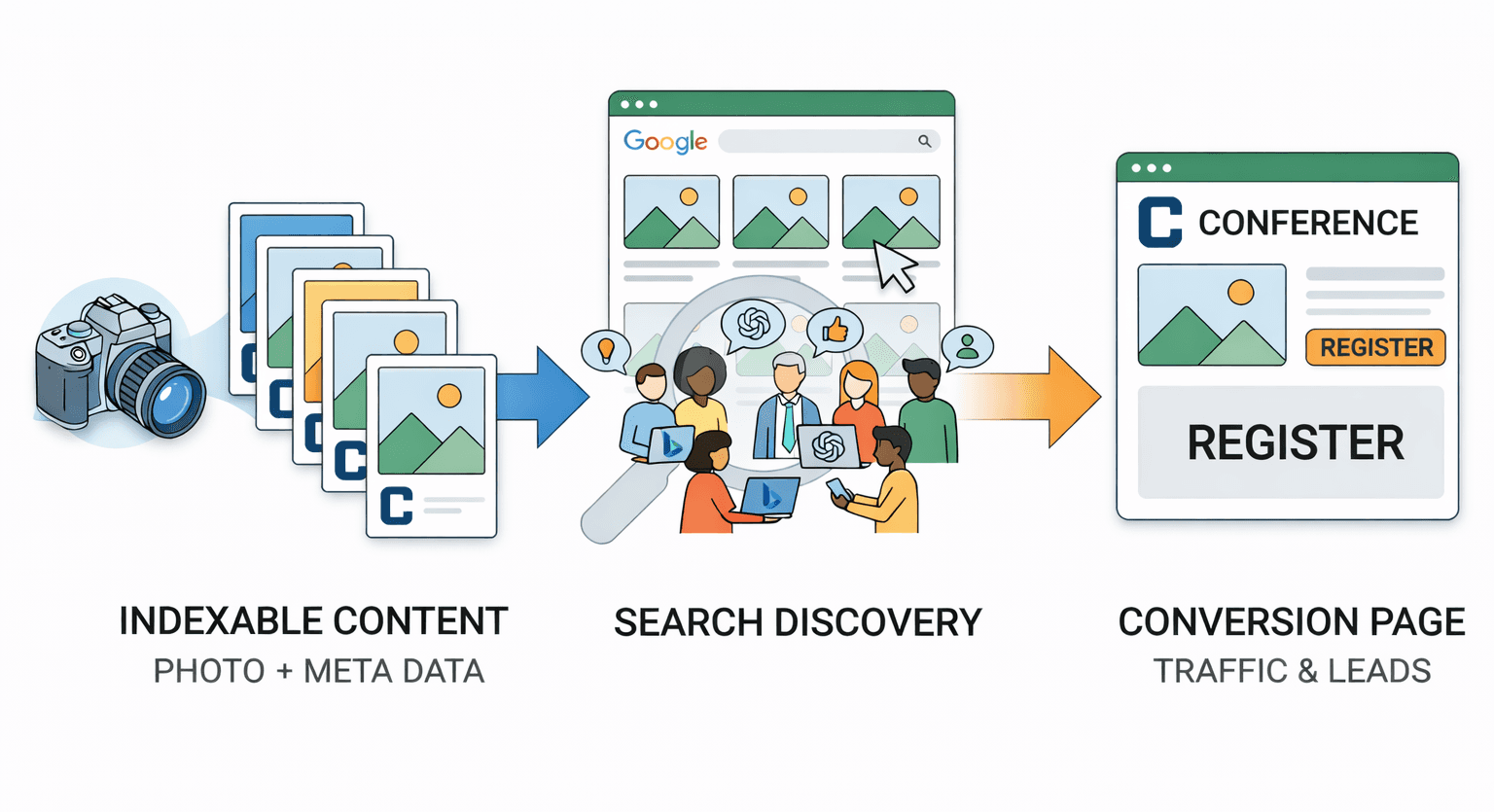
Captions like “X and Y at event Z” become more than just documentation: each term turns into a search surface and a click opportunity, which has the potential to drive thousands of visitors to your organization's websites and conversion funnels.
What discovery-oriented event photography requires
- Strong captions and metadata for every photo, not just file uploads. These usually consist of people, organizations, sponsors, and event context
- Other basic image SEO: descriptive filenames, alt text, and structured data where appropriate
- Image pages designed to be publicly indexable by search engines
- Clear owner attribution and brand presence around the photo itself
With all the above, event photography starts to look less like a one-time media expense and more like an durable marketing asset. If event photos help people discover your organization, event series, membership offering, venue, or future programming, then the archive is doing top-of-funnel work long after the room is empty.
Many gallery tools such as Flickr, SmugMug, and Pixieset are not designed as brand-discovery engines. In a sample of ten public galleries on each site, we found that (A) the photo pages were not publicly indexed, (B) the photographer or owning brand was hard to find (hidden somewhere below the photo), and (C) the path back to the host’s websites didn't exist (often intentionally so, to keep the user on the site). This limitation is even more pronounced with DAM platforms like PhotoShelter, Canto, and MediaValet. These systems were built for storage, organization, and internal marketing team retrieval, and not for organic discovery.
By contrast, platforms like Getty, Instagram, and Portraiteer are designed to showcase your brand's identity, the photo's attribution, and enable profile-level discovery. They make the photo's owner and brand part of the experience, not a hidden detail. If your goal is ROI from events, the platform matters. A private or weakly branded archive may preserve files, but it does little to expand awareness or bring new people into your orbit. A public, well-structured, well-attributed image archive can.
2. Relationship ROI: Every photo is a stakeholder touchpoint
The second ROI path is more direct. Every person who attends your event has already signaled some level of interest, relevance, or affinity with your organization. They may be a customer, prospect, donor, sponsor, member, VIP, speaker, partner, or future repeat attendee. This matters because for many teams, the whole point of event marketing is relationships; to strengthen loyalty of existing stakeholders, and to build relationships with new ones.
We believe photos are a natural record of interactions, which makes event photos powerful in follow-up. In addition, following up with a personalized photo of a person attending your event serves as a reason to connect that feels personal rather than spammy. Instead of sending the same generic follow-up email to all attendees, savvy event hosts send a highly individualized photo memento tied to a person’s actual experience at the event.
- For commercial events, this drives repeat attendance, upgrades, and future bookings.
- For nonprofits, it supports stewardship and move donors further up the ladder.
- For membership and community organizations, it strengthens retention, loyalty, and re-engagement.
What relationship-oriented event photography requires
- Automatic tagging and person-level retrieval, so the archive is usable by individual, not just by folder
- Private or personalized delivery surfaces, so follow-up feels direct and high-touch
- A workflow that lets the team return to the archive repeatedly instead of rebuilding the same manual search every time
Without these capabilities, most teams fall into the default pattern: upload the gallery, send a broad recap, and reserve personalized outreach for a small handful of VIPs. The result is that the majority of the new relationship value goes unrealized.
The practical recommendation
If you want event photography to generate positive returns, you need to be smarter about using it more broadly to create discovery and relationship surfaces.
This obviously requires event photographers to capture high-quality base material. But after receiving the photos, competent teams need methods to automate and scale the creation of better metadata and captions, person-specific tags, and follow-up schedules. The teams that do this well are not treating images as static records, but rather as content marketing and sales engines for growth.
Where Portraiteer fits
Portraiteer is designed to help teams capture both motions in this ROI model. For discovery, it helps teams by automatically tagging people in your photos and generating rich metadata and caption context, and turning every photo into a publicly discoverable landing page for your brand. For relationships, Portraiteer helps teams automatically retrieve the best photos of every attendee by name, support personalized follow-up, and turn event participation into a longer-lasting relationship asset.
Want event photography to drive more than a recap gallery?
If your team is trying to turn event photos into discovery surface, stakeholder follow-up, and measurable relationship value, a short walkthrough can show what that looks like in practice.